The Emperor's Last Victory by Gunther E Rothenberg
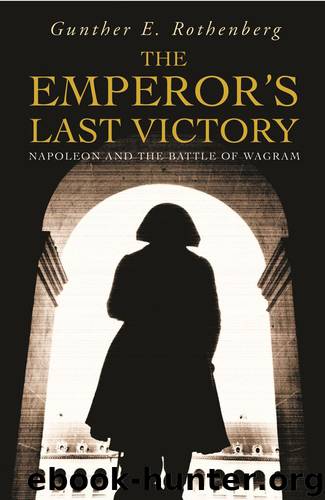
Author:Gunther E Rothenberg [Rothenberg, Gunther E]
Language: eng
Format: epub
ISBN: 9781780226989
Publisher: Orion
Published: 2013-10-17T00:00:00+00:00
THE AUSTRIAN BATTLE PLANS
The Austrian army had suffered substantial losses at Aspern-Essling and replacements and reinforcements were trickling in only slowly. Given this situation, Archduke Charles was in no mood to chance another major battle, and certainly not in a position to take the offensive. The question was how best to fight a defensive battle. Charles expected a renewed French attack, but he and his staff believed it would come across from the Lobau north, essentially in the same direction as on 20 May. He pulled back his main body to the line of the Russbach-Bisamberg, leaving only VI Corps and the Klenau’s Advance Guard to watch the river line and begin construction of a chain of sixteen defensive redoubts. The former quartermaster-general, von Heldenfeld, who had been one of the young archduke’s military mentors, observed rather scathingly that only Turks would throw up such poorly designed earthworks.11 Not always well sited and providing no all-round protection, the majority of these rather weak works, emplacing some seventy-two field pieces, were concentrated between Aspern and Gross Enzersdorf. The last work, located at the extreme left of the Austrian line, was established below the Ile Alexandre in the Hanselgrund, an area of meadow and brush near the junction of the Stadlau branch into the Danube. But this left a 3-mile stretch along the water unprotected. Curiously, although it would have been feasible within three weeks, Charles made no effort to draw on the heavy artillery available in the arsenals in Bohemia and Moravia to strengthen his works along the river line.
The archduke was concerned with strengthening his army but he was unwilling and unable to concentrate all available major combat formations. From Linz, he brought the bulk of Kolowrat’s III Corps, but left about a third behind. Then there was FML Ignaz Gyulai’s corps near Graz, about 20,000 strong, also left in place. Also not available were two mixed detachments under Generals Ende and von Radivojevic, some 12,000 men, who in June had been sent from northern Bohemia to raid into Saxony and the Main region in the hopes of raising the population. Although initially well received, their appeals for volunteers yielded but a total of eighty-six men, illustrating that hopes of a popular rising in Germany were illusory. Clearly he could not recall Archduke Ferdinand’s corps from Galicia. Though on 2 July the Emperor Francis, never shy of interfering in military affairs and of bypassing Charles, would write to Wimpffen, that ‘unless you intend to conduct a major action in the next few days, 12–15,000 men should be sent to Galicia’.12 Meanwhile, Hungary provided the noble mounted insurrectio, the old feudal levy called out by Archduke Palatine Joseph, but who was reluctant to make demands for more men and was not inclined to cooperate with either John or Charles. In any case, the mounted insurrectio and the Portal militia, untrained infantry, lacked combat capabilities and the palatine feared that further call-ups might only provoke uprisings. This left Archduke John’s Army of
Download
This site does not store any files on its server. We only index and link to content provided by other sites. Please contact the content providers to delete copyright contents if any and email us, we'll remove relevant links or contents immediately.
| Africa | Americas |
| Arctic & Antarctica | Asia |
| Australia & Oceania | Europe |
| Middle East | Russia |
| United States | World |
| Ancient Civilizations | Military |
| Historical Study & Educational Resources |
Room 212 by Kate Stewart(5119)
The Crown by Robert Lacey(4814)
Endurance: Shackleton's Incredible Voyage by Alfred Lansing(4780)
The Iron Duke by The Iron Duke(4354)
The Rape of Nanking by Iris Chang(4211)
Joan of Arc by Mary Gordon(4109)
Killing England by Bill O'Reilly(4001)
Say Nothing by Patrick Radden Keefe(3983)
I'll Give You the Sun by Jandy Nelson(3445)
Shadow of Night by Deborah Harkness(3367)
Hitler's Monsters by Eric Kurlander(3341)
Mary, Queen of Scots, and the Murder of Lord Darnley by Alison Weir(3210)
Blood and Sand by Alex Von Tunzelmann(3203)
Eleanor & Park by Rainbow Rowell(3170)
Darkest Hour by Anthony McCarten(3129)
Margaret Thatcher: The Autobiography by Thatcher Margaret(3081)
Book of Life by Deborah Harkness(2938)
Red Famine: Stalin's War on Ukraine by Anne Applebaum(2932)
The One Memory of Flora Banks by Emily Barr(2863)
